
Software development is always evolving, and we've witnessed a monumental shift from monolithic applications to more granular microservices, offering enhanced flexibility and scalability. However, it also presents challenges, especially in ensuring the consistent management of data across various interconnected systems.
Before we dive into data consistency challenges and discuss the design patterns that can address data consistency issues, let me start with the basics of Microservices.
Understanding Microservices
Microservices represent an architectural style that breaks down an application into loosely coupled services. Each of these services handles a distinct functionality or business capability. They operate independently, typically communicating through lightweight mechanisms, often an HTTP API.
Key Principles of Microservices:
Single Responsibility: Each service caters to one specific business function.
Decentralized Data Management: Services maintain their own database, promoting data consistency within its confines.
Scalability: Services can be scaled and deployed independently.
Inter-Service Communication: Primarily through APIs or messaging queues, this ensures a low degree of coupling between services.
Isolated Failures: The independence of services means the failure of one doesn’t compromise others.
Business-Centric Design: Organize services around business functionalities.
Infrastructure Automation: CI/CD pipelines are vital for a seamless development lifecycle.
The Dilemma of Data Consistency
For developers navigating the world of microservices, data consistency feels like solving a complicated problem. With each service owning its database, how does one ensure data remains consistent across microservices? How do you coordinate operations that span multiple services? How can the system remain resilient in the face of partial failures? These are just a few of the questions developers ponder and grapple with.
Challenges in a Microservices Architecture:
Decentralized Data Management: Microservices manage their databases, making a single source of truth elusive. Example: In a microservices-based e-commerce platform, the inventory service and order service might have separate databases. Ensuring that the inventory is updated across both services can be challenging when an item is ordered.
Lack of Transactions Across Services: Transactions across microservices are complex, making the all-or-nothing principle hard to maintain. Example: If a customer makes a purchase involving order, payment, and shipping services, and the payment succeeds but shipping fails, rolling back the entire transaction to maintain data consistency becomes difficult.
Eventual Consistency: Microservices might not reflect data changes instantly, leading to potential data discrepancies. Example: A user updates their delivery address in one service of an e-commerce platform. Another service responsible for sending out promotional mailers might still have the old address, leading to mail going to the incorrect location.
Network Latency and Failures: Communication over networks can introduce delays or failures. Example: In a hotel booking platform, a user tries to book a room. Due to network latency, the inventory service doesn’t update instantly, potentially allowing another user to book the same room.
Distributed Transaction Management: Managing transactions across services is challenging. Example: In a travel booking platform, users book flights and hotels together. If the flight booking succeeds but the hotel booking fails, the system needs a mechanism to cancel the flight booking to ensure the user isn't charged for a half-completed transaction.
Addressing Challenges by Using the Saga Pattern
Design patterns like the Saga Pattern emerge as solutions to address these challenges.
What is the Saga Pattern?
The Saga Pattern breaks a single monolithic transaction into smaller transactions that execute within their respective microservices. These smaller transactions are coordinated to ensure data consistency across services.
How Saga Pattern Works
1.) Local Transaction: Each step in a saga executes a local transaction, including changes only within a single service and not impacting any other service.
2.) Compensating Transaction: If a step within a saga fails, the preceding steps must be compensated or reversed to ensure data consistency. It's the compensating transaction's responsibility to undo the previous actions.
3.) Coordination: Sagas can be coordinated in two primary ways:
Choreography: Every local transaction publishes domain events to which other services can react. There's no central coordination.
Orchestration: A specific service (or coordinator) is responsible for the central management of the saga, telling each participant what local transaction to execute.
Saga in Action: The Payroll Example
Consider a scenario in a company's payroll system where an employer approves a payroll:
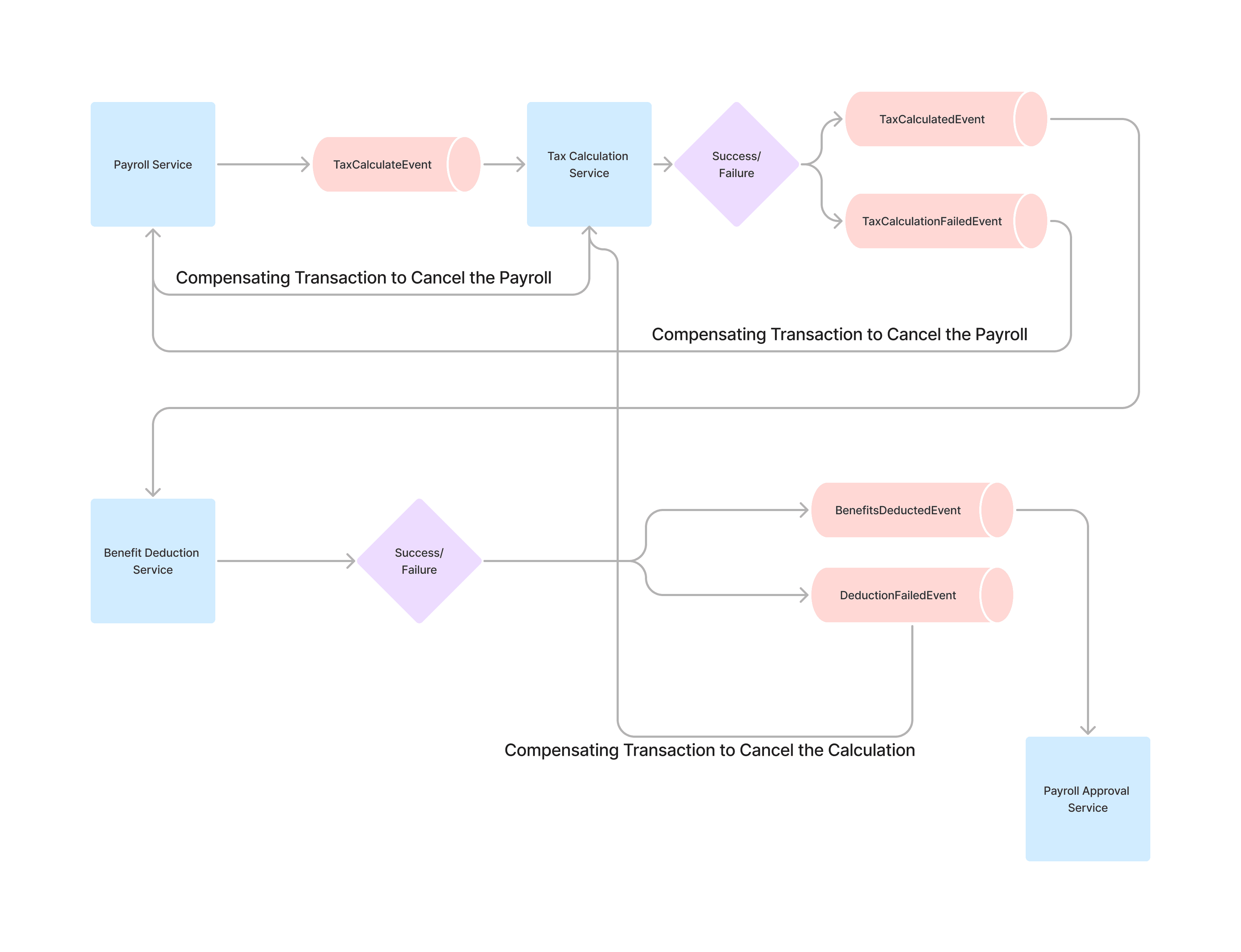
Payroll Initiation Service: The employer initiates the payroll process. The Payroll Initiation service starts the saga by creating a payroll entry in a 'pending' state and then sends an event to the Tax Calculation service to compute tax deductions.
Tax Calculation Service: Upon receiving the event or command, this service calculates the tax based on the employee's salary and other applicable deductions. If successful, it emits a TaxCalculated event. If it fails, for example, due to missing tax-related information, it emits a TaxCalculationFailed event.
Benefits Deduction Service: If the Tax Calculation service successfully computes the tax and emits the TaxCalculated event, the Benefits Deduction service then calculates any applicable benefits (like health insurance or pension contributions). On successful deduction, a BenefitsDeducted event is emitted. If the deduction process fails, a DeductionFailed event is emitted.
Payroll Approval Service: It listens to the events from the Tax Calculation and Benefits Deduction services. Depending on these events, the payroll entry can move to an 'approved' state (if both tax calculation and benefits deduction are successful) or to a 'canceled' state (if either action fails).
Compensating Transactions: If the Benefits Deduction service fails after the Tax Calculation service has successfully calculated tax, the saga must handle this inconsistency. The Payroll Approval service, upon receiving a DeductionFailed event, might initiate a compensating transaction. This could involve sending a command to the Tax Calculation service to revert the previously computed tax, ensuring the employee isn't inadvertently taxed without receiving the appropriate benefits.
This workflow ensures that even without traditional coordinated transactions across services, data stays consistent throughout them. The system remains independent and manageable.
The Image below highlights the Orchestration of Payroll Approval workflow using Saga Pattern:
Key Takeaways
Sagas maintain data consistency across multiple services without the need for distributed transactions.
Sagas can be coordinated using either choreography or orchestration.
A failed step within a saga triggers compensating transactions to restore consistency.
Concluding Thoughts
The Saga Pattern plays a pivotal role in maintaining data consistency across services, eliminating the need for complex distributed transactions. Through choreography or orchestration, sagas provide a structured approach to handle inconsistencies. As microservices continue to dominate the software landscape, ensuring data integrity becomes paramount. With the right strategies and understanding of patterns like Saga, developers can build robust, scalable, and consistent systems.