
MCP, RAG, and memory make LLMs undeniably better tools. They do not turn them into minds, and engineering leaders who confuse the two are about to make costly architectural mistakes.
Why E ≠ LLM²
Every engineering leader I speak to right now is being asked the same question by their board: What is our AGI strategy? The question is usually asked seriously, as if AGI were on a roadmap somewhere between SSO and the next Kubernetes upgrade. It is not. And if you build your platform strategy assuming it is, you'll spend the next two years wiring your business around a capability that doesn't exist.
I want to narrow the argument and make it more practical than the usual AGI debate allows. The recent surge of LLM improvements, MCP, retrieval-augmented generation, persistent memory, tool use, and longer contexts is real. These are genuine engineering wins. They are also often misinterpreted by vendors and product teams as signs that the model is getting smarter in a deep way. It is not. It is simply getting better connected.
That distinction is vital because it influences what you should build, what you should buy, and where you should focus your investments. The thing we keep confusing
Einstein’s E = mc² is a predictive law. Given mass, it directly tells you how much energy there is. The universe obeys this law, as proven through measurements. The math behind a large language model is different. A transformer reduces cross-entropy loss relative to a training data distribution. It learns to predict the next most likely token. This is a remarkable engineering achievement, but it’s a statistical optimizer, not a theory of cognition. Nothing in the loss function predicts reasoning emerging in the way relativity predicts light bending.
So, when the industry claims “we will scale our way to AGI,” what they really mean is that if we keep reducing prediction error on a large enough dataset, general intelligence might appear as a side effect. That’s a hope, not a prediction. If it happens, it’s a coincidence we stumbled upon, not a math guarantee. This gap exists between a predictive law and a wish. Your architecture choices should respect that difference.
MCP, RAG, and memory are plumbing, not cognition
Let me be clear, this may be a tough truth for some.
MCP offers models a standardized way to call tools. RAG gives access to information they weren’t trained on. Memory maintains continuity across sessions. Longer context windows enable them to see more of a problem at once. All four are valuable engineering improvements. I use them. You should, too.
None of these alters what the model fundamentally does: predicting the next token. We’ve given it better reference material, better tools, and a larger workspace.
Think of it like a highly capable intern. Giving this intern access to your wiki (RAG), a company laptop with internal tools (MCP), and a notebook (memory) makes them far more helpful. But it doesn’t make them a senior engineer. To become a senior engineer, judgment gained through experience is essential, not just having better tools.
Current product discussions often blur this line. A model that can now book a flight via MCP is called “more agentic,” as if agency were just a knob to turn up. What actually happened is that we exposed a new API surface. The model has no greater understanding of flights or reasons for traveling than it did before; it just has hands now.
Where this fails in practice
This isn’t just theory. Confusing plumbing with reasoning leads to predictable failure in enterprise deployment:
Stacked controllers: teams put a “judge” model over a “worker” model, thinking it improves reliability. It does not. Two probabilistic systems in series multiply failure points, not reduce them. If the judge depends on the worker being right, it’s just a committee of guesses.
Tool sprawl: because integrating tools costs little, teams build multi-agent workflows that branch into many calls, each adding hallucination risk. A five-step process with 95% accuracy each yields roughly 77% overall accuracy, customers notice.
RAG as a fix for correctness: retrieval is excellent for freshness and grounding, but doesn’t enhance reasoning or understanding. If the model can’t reason about a topic without a document, more documents won’t help.
Memory as a moat: persistent memory makes products seem more personalized, which is valuable, but it’s not a strategic defense. Anyone can add memory to a base model. The idea that it’s a competitive advantage is a category error that competitors will easily surpass with better UX.
None of these are inherently wrong, but adopting them while believing you are building toward intelligence rather than a better autocomplete tool is misguided.
A framework for deciding what to build
When a proposal depends on LLM capability, run it through four questions first. I call this the Reducibility Test, inspired by Stephen Wolfram’s idea that pattern matching works within pockets of computational reducibility but fails outside.
1. Is the task reducible? Can a skilled human solve it by recognizing patterns, or does it require genuinely new multi-step reasoning under uncertainty? LLMs excel at the first but fail sharply at the second, regardless of prompts or context.
2. What’s the cost of being wrong? A confident but wrong answer in drafting delays revision; in medical, legal, or financial contexts, it could lead to lawsuits. Adjust your tolerance based on potential impact. Humans-in-the-loop are a feature, not a flaw.
3. Is the benefit from just scaling, or from good scaffolding? If your pilot succeeds because GPT-5 beats GPT-4, you’re betting on the lab. If it’s because you built solid retrieval and fallback systems, you’re betting on your engineering, which is more reliable over time.
4. Could a deterministic system do this? Many so-called “AI-powered” features are pattern-matching problems that can be solved more reliably and cheaply with SQL, rules, or classifiers. If there’s a known answer, avoid using a probabilistic model.
What to do tomorrow
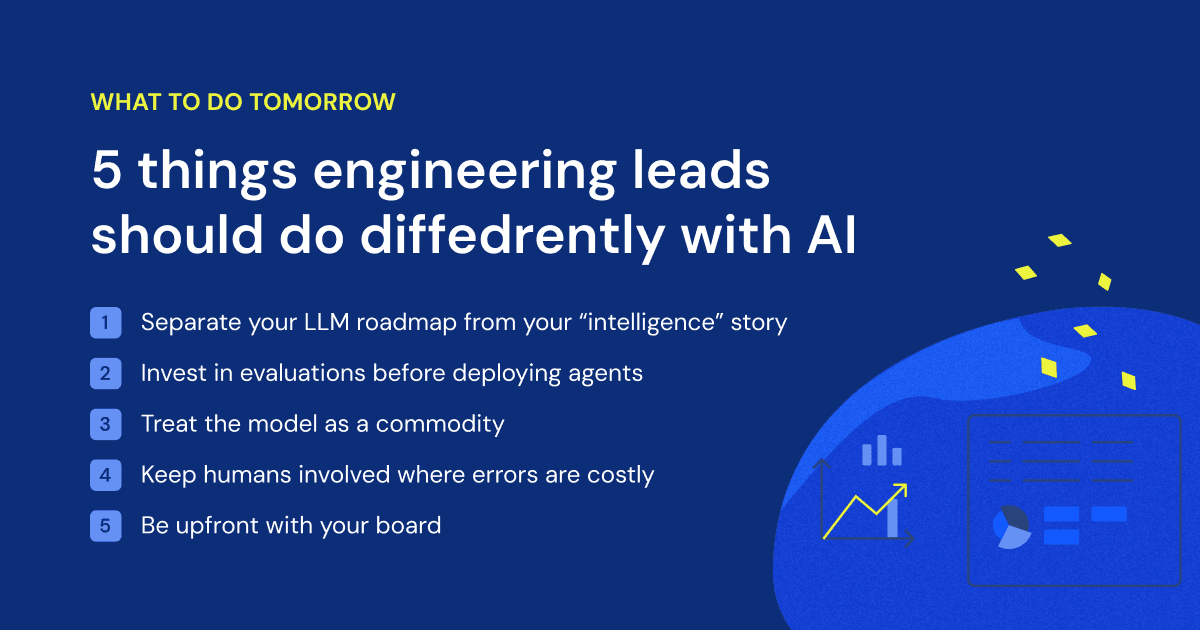
Keep your LLM roadmap separate from your “intelligence” story. Use MCP, RAG, and memory where they add value. Never claim they’re steps toward AGI, that generates unrealistic expectations.
Invest in evaluations before deploying agents. Quantitative measures tied to business outcomes are more valuable than solely releasing new model versions. If you can’t measure progress, you can’t manage it.
Treat the model as a commodity. Assume the underlying model will change every 12–18 months. Build interfaces that are vendor-agnostic. Anything that depends on a single vendor’s quirks is a liability.
Keep humans involved where errors are costly. This isn’t a sign of failure but wise engineering amid uncertainty. The teams that succeed will position models where they truly add value.
Be upfront with your board. If leadership believes AGI is only two product cycles away, correct that. Clarify the facts rather than pursue a flawed strategy based on unsupported math.
The closing point
LLMs are the most valuable new tool engineering has seen in a decade. But they are not what much of the industry claims. Our role is to take the tools seriously without being misled by marketing.
Scale has given us an exceptional guessing machine. It has not given us a mind. Build with that in mind, and your architecture will remain sound when the next hype cycle emerges.