
Introduction
In recent months, the astronomical adoption of LLM-powered generative AI has begun to shift the way we conduct our daily lives. AI’s many use cases have started to open the eyes of business executives looking to boost their productivity and keep up with the latest technologies. Within Software Development and DevOps teams, leaders are beginning to implement the power of AI to boost productivity and strengthen processes.
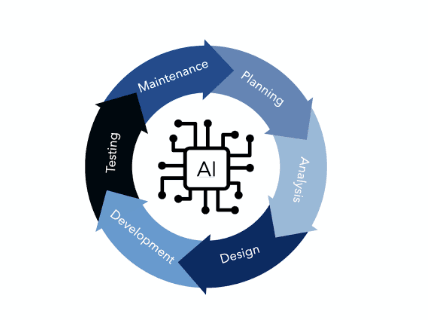
One domain where AI is proving to be transformative is in the software development lifecycle (SDLC), particularly in the Continuous Integration, Continuous Delivery, and Continuous Testing (CICDCT) pipeline. In this post, we explore various ways AI enhances the SDLC process, from code completion and review to documentation and test automation.
Code Completion
AI-powered code completion tools are the most popular Generative AI use case among developers. These tools utilize LLMs to analyze code contexts and suggest accurate and context-aware code snippets. Some notable examples include:
Github Copilot: Developed by OpenAI in collaboration with GitHub, Github Copilot is a revolutionary code completion tool that understands natural language comments and generates entire code blocks accordingly. It leverages the power of OpenAI’s Codex to provide highly relevant code suggestions. Currently, Copilot X, the latest extension of Copilot, is in technical preview and utilizes GPT-4 and has broader chat-like functionality.
TabNine: Similar to Copilot, TabNine is an AI-based autocompletion tool whose main selling point is the ability to run code-completion in full isolation, preventing developers from exposing company code. It also reads your comments and learns from in-house code. TabNine was founded in 2013 out of Tel Aviv, Israel.
Code Review
Effective code reviews are critical for maintaining code quality. By integrating tools like OpenAI’s Code Interpreter feature, released in July 2023, companies can automate code reviews, leading to faster feedback cycles and improved code quality. The AI-driven code review process involves:
Automated Review Feedback: The AI analyzes code changes and identifies potential issues such as coding standards violations, performance bottlenecks, and security vulnerabilities. Developers receive automated feedback, allowing them to address the identified concerns promptly.
Intelligent Recommendations: AI-powered code review tools can offer intelligent recommendations on best practices and design patterns, guiding developers to write cleaner, more efficient, and maintainable code.
Security Analysis: By combining AI-powered code review with security-focused models, companies can strengthen their codebase's security. The AI can identify potential security loopholes, ensuring that developers follow secure coding practices.
Code Documentation
Generating code documentation has long been a time-consuming task for developers. However, Generative AI can automatically create code summaries and release notes.
Code Summary Generation: AI-powered tools can analyze the codebase and generate meaningful summaries for functions, classes, and modules. This helps developers and stakeholders quickly understand the purpose and functionality of the code.
Release Notes Generation: AI can analyze code changes and create comprehensive release notes, outlining the additions, modifications, and bug fixes made in each release. This ensures that stakeholders stay informed about the latest updates.
Test Automation
QA teams can streamline the testing process by harnessing new Generative AI tools. Examples of this include:
Unit Test Automation: AI-powered testing tools can analyze the code changes made in a pull request and automatically generate relevant unit tests. This aids in early bug detection and ensures that new code does not introduce regressions.
Automated UAT Testing: AI-driven automation using Selenium frameworks allows developers to automate UAT testing. The AI can simulate user interactions, ensuring that the application functions as expected from an end-user perspective.
Test Data Creation: AI can generate diverse and representative test data, ensuring comprehensive test coverage and reducing the reliance on manually created test data.
Conclusion
Although we are still in the beginning stages of using generative AI in our daily lives, it is evident that there have been significant technical advancements in certain areas of SDLC. AI is poised to revolutionize the average corporate tech stack and developers' work processes.
My prediction for future development workflows is:
Analysts will quickly draft requirements based on notes generated from video meetings, converting them into user stories.
Developers will design technical architecture, and AI will handle approximately 80% of the coding, drastically reducing overall development time.
The majority of positive test scenarios will be automatically generated and tested by AI using its own generated data and theory.
With automation and optimization at the forefront, AI will exponentially increase tech teams’ output. Embracing AI in the SDLC process will be crucial for companies to stay competitive and deliver cutting-edge solutions in today's fast-paced technological landscape.